





Flow & Products
Light, regular or heavy? Understanding your flow
How to tell what kind of flow you have, what colours and clots mean, and the clear signs that heavy bleeding is worth checking with a doctor.
Key takeaways
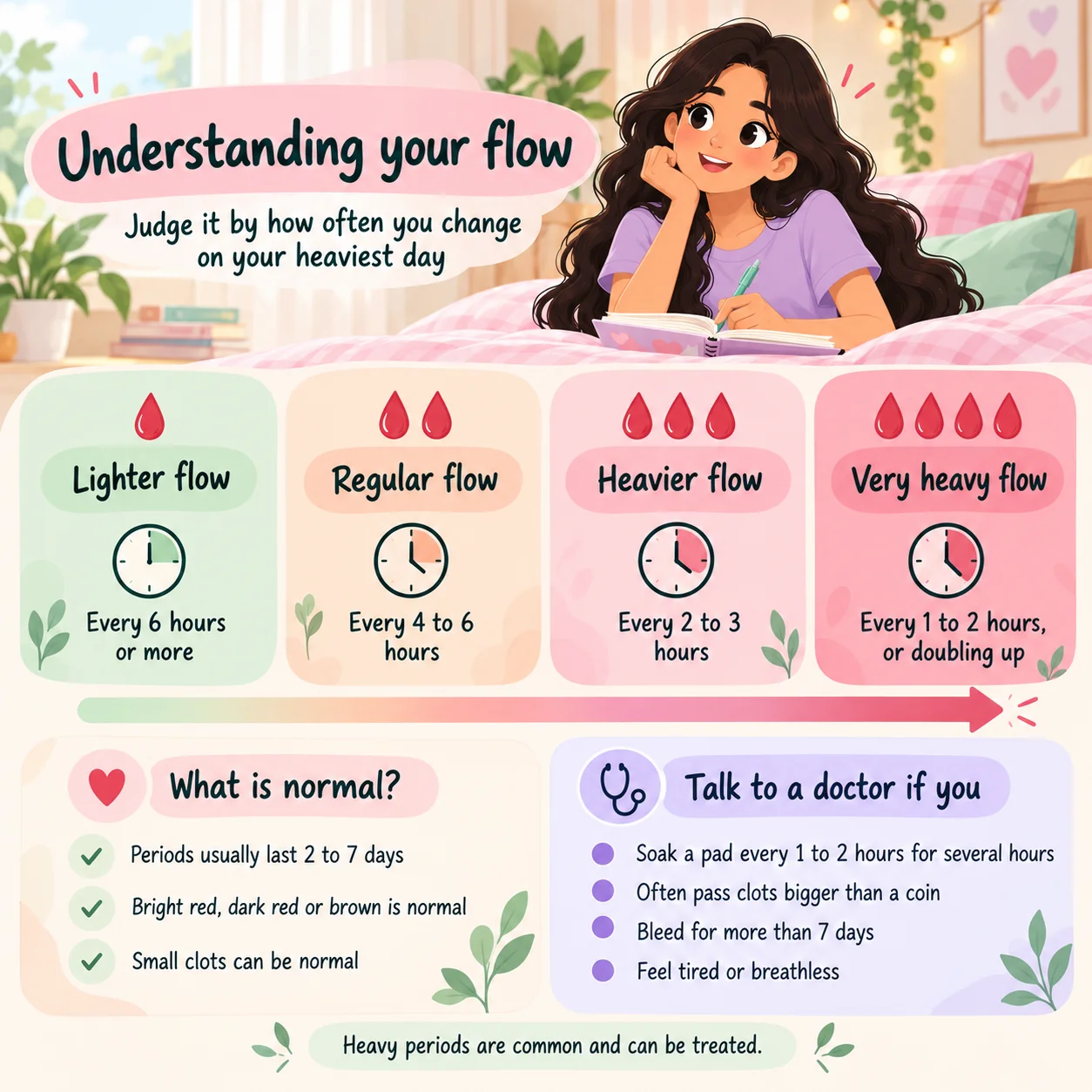
- The best way to judge your flow is how often you need to change on your heaviest day.
- A typical period loses about 20 to 90 ml of blood (1 to 5 tablespoons) over several days.
- Bright red, dark red and brown blood are all normal, and small clots can be too.
- Changing every 1 to 2 hours, clots bigger than a coin or periods over 7 days need a doctor’s check.
1. Judge flow by how often you change
“Heavy” means different things to different people, so the most useful guide is how often you need to change on your heaviest day:
- Every 6 hours or more: lighter flow.
- Every 4 to 6 hours: regular flow.
- Every 2 to 3 hours: heavier flow.
- Every 1 to 2 hours, or needing two pads at once: very heavy flow — talk to a doctor.
2. How much blood is normal?
It often looks like more than it is. A typical period loses about 20 to 90 ml of blood — roughly 1 to 5 tablespoons — spread over several days. Some people bleed more than this.
Flow usually changes over a period: heavier in the first 2 days, then lighter towards the end. Doctors say a normal flow for teenagers needs a pad change about 3 to 6 times a day.
3. Colours and clots: what is normal?
Most periods last 2 to 7 days. Period blood can look different from day to day:
- Bright red: fresh blood, often on heavier days.
- Dark red or brown: older blood that left the body more slowly, common at the start and end.
- Pink: light flow mixed with discharge.
- Small clots (smaller than a coin): normal, especially on heavy days.
Grey or green-tinged discharge, or a strong fishy smell, can be a sign of infection — see a doctor.
4. Why your flow changes
Your flow can vary from month to month and over your life. It is often heavier in your teens, steadier in your 20s and 30s, and can change again in your 40s as you approach menopause.
Stress, illness, weight change, hormonal contraception, some medicines and conditions such as fibroids, PCOS or thyroid problems can also make periods heavier or lighter.
5. Signs of heavy periods
Heavy periods (doctors call them menorrhagia) are common. According to the NHS, signs include:
- Changing your pad every 1 to 2 hours.
- Passing clots bigger than about 2.5 cm (around the size of a coin).
- Needing to use two period products at once.
- Periods lasting more than 7 days.
- Bleeding through to your clothes or bedding.
- Avoiding activities, school or work because of your period.
- Feeling tired or short of breath a lot.
6. When to see a doctor
See a doctor if heavy periods are affecting your life, if you have any of the signs above, or if you bleed between periods or after sex. Heavy bleeding over time can lead to low iron (anaemia), which makes you feel tired and breathless — a simple blood test can check.
Heavy periods are common and can be treated, so there is no need to put up with them.
7. FAQs
Sources & further reading
- Heavy periodsNHS (UK National Health Service)
- PeriodsNHS (UK National Health Service)
- Menstruation in girls and adolescents: using the menstrual cycle as a vital signAmerican College of Obstetricians and Gynecologists (ACOG)
- Your menstrual cycleOffice on Women’s Health, U.S. Department of Health and Human Services
This article is general information, not medical advice. For diagnosis or treatment, please speak to a qualified healthcare professional. In an emergency, call 112.