




Free shipping on orders above ₹499 Get 10% off on your first order| Code: WELCOME10
PIAX — Feel different. Feel you.
HomeShopFind My PadBusinessPIAX AILearnAboutCareers
  1. Home
  2. Learn
  3. Hygiene
  4. How to dispose of pads responsibly

Hygiene

How to dispose of pads responsibly

Clean, considerate pad disposal at home, school, work and while travelling — following India’s official guidance on sanitary waste.
By the PIAX Health TeamMedical review pending Updated 7 Oct 2026 2 min read
Share
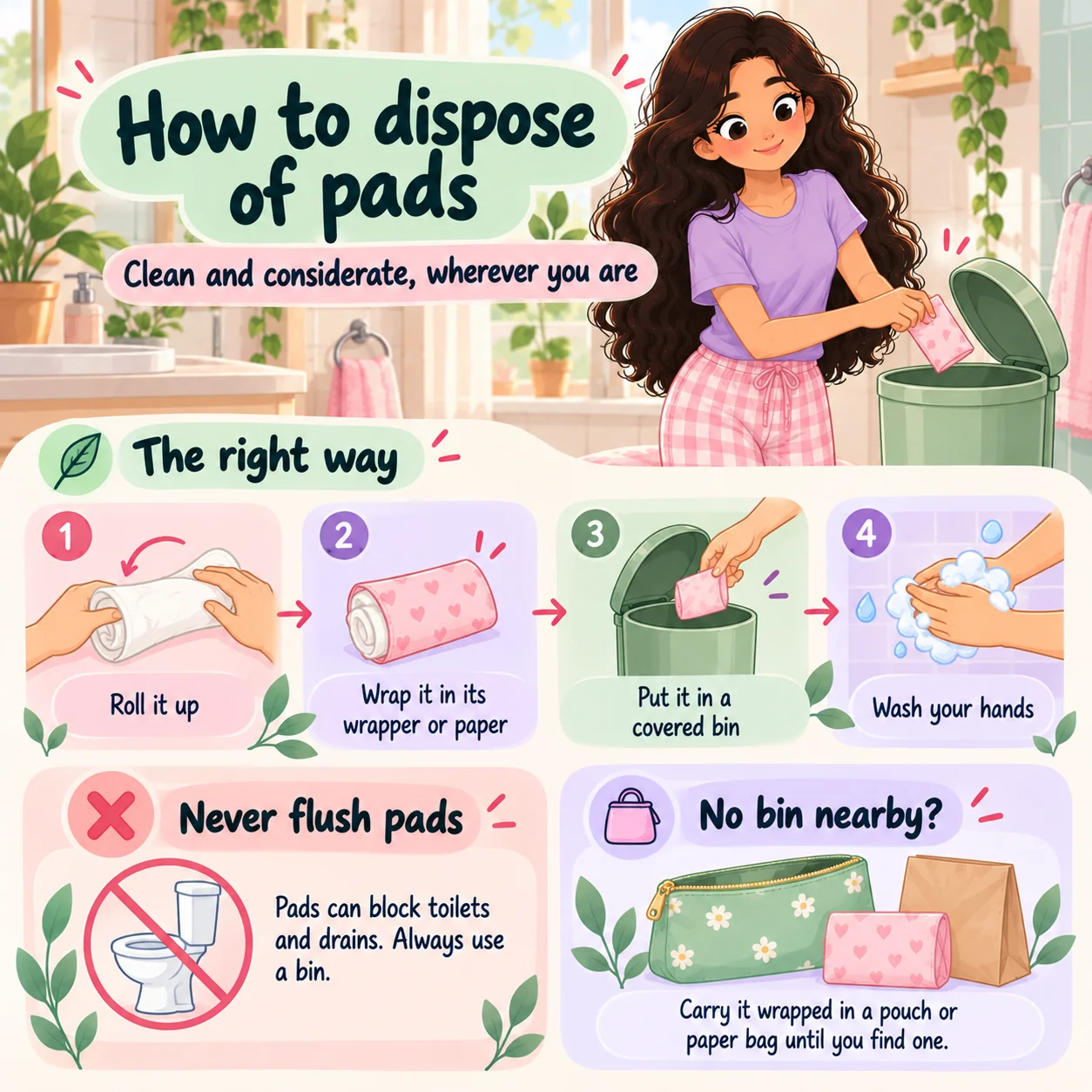
How to dispose of pads, clean and considerate wherever you are. The right way: 1 roll it up, 2 wrap it in its wrapper or paper, 3 put it in a covered bin, 4 wash your hands. Never flush pads: they can block toilets and drains, so always use a bin. No bin nearby? Carry it wrapped in a pouch or paper bag until you find one

Key takeaways

  • Roll up the used pad, wrap it securely, and put it in a covered bin.
  • India’s guidelines say wrapped sanitary waste goes in the dry (non-biodegradable) waste bin.
  • Never flush pads — they block toilets and drains.
  • If there’s no bin, carry the wrapped pad in a pouch until you find one.

In this article

  1. 1. Why disposal matters
  2. 2. The right way
  3. 3. At home: which bin?
  4. 4. Never flush pads
  5. 5. At school, work or while travelling
  6. 6. Why not burn or bury pads?
  7. 7. FAQs
  8. 8. Sources & further reading

1. Why disposal matters

Disposing of pads properly keeps your home and shared toilets clean, protects the people who handle waste, and stops blockages in toilets and drains.

India’s Solid Waste Management Rules (2016) and the Central Pollution Control Board’s guidelines on sanitary waste ask everyone to wrap used pads securely before throwing them away.

2. The right way

  1. Step 1Roll the used pad up, sticky side in
  2. Step 2Wrap it in its wrapper, a pouch or paper
  3. Step 3Put it in a covered bin
  4. Step 4Wash your hands

3. At home: which bin?

Under India’s guidelines, wrapped sanitary waste goes in the bin for dry or non-biodegradable waste — not the wet (kitchen) waste bin. Wrapping it securely means waste collectors don’t have to touch it.

A small bin with a lid in the bathroom makes this easy and keeps things discreet.

Many pads come with a wrapper or disposal pouch for exactly this reason — use it to wrap the used pad.

4. Never flush pads

Pads are made to absorb liquid, so they swell up in water. They can block toilets, pipes and sewers, causing overflows and expensive repairs. Always use a bin, even if one is not right next to you.

5. At school, work or while travelling

  • Use the sanitary bin in the toilet cubicle if there is one.
  • If there is no bin, wrap the pad well and put it in a regular dustbin outside the cubicle.
  • Keep a small zip pouch or paper bag in your kit to carry a wrapped pad until you find a bin.
  • Wash your hands or use hand sanitiser afterwards.

6. Why not burn or bury pads?

Burning pads at home in the open can release harmful smoke, and burying them can pollute soil and water. Wrapping them and using the household waste system is the safer option. Some schools and offices have special sanitary-pad incinerators designed to do this safely.

7. FAQs

It is best not to. Open burning releases harmful smoke. Wrap them and use the household dry-waste bin.

Wrapped securely, they go in the dry or non-biodegradable waste bin, as recommended by India’s sanitary waste guidelines.

Wrap the pad well in paper or a pouch and put it in the nearest dustbin, or carry it in your kit until you find one.

No. Wrappers and pads should never be flushed — they can block pipes.

Sources & further reading

  • Guidelines for management of sanitary waste (2018)Central Pollution Control Board, Government of India
  • Menstrual hygiene productsUNICEF Supply Division

This article is general information, not medical advice. For diagnosis or treatment, please speak to a qualified healthcare professional. In an emergency, call 112.

Related articles

See all
  • HygieneMenstrual hygiene: a complete guide3 min read
  • First PeriodWhat happens when you get your first period?5 min read
  • Menstrual CycleWhat is the menstrual cycle?3 min read
  • Period CareHow to use a sanitary pad correctly3 min read

Have a question?

Ask PIAX

Simple, judgement-free answers to your menstrual health questions.

Ask PIAX AI

You might also like

See all articles
Daily hygiene

Menstrual hygiene: a complete guide

Simple, practical steps for staying clean, fresh and comfortable during your period — what to do, what to avoid, and how to manage on the go.

3 min read · 1 Oct 2026

Understanding

What happens when you get your first period?

A simple, friendly guide to your first period: what it is, the signs it may be coming, what it looks and feels like, and when to ask for help.

5 min read · 1 Oct 2026

Cycle basics

What is the menstrual cycle?

A simple guide to what the menstrual cycle is, how to count it, what a normal cycle looks like, and why tracking it is good for your health.

3 min read · 1 Oct 2026

Using pads

How to use a sanitary pad correctly

A step-by-step guide to putting on, changing and disposing of a pad comfortably and hygienically — plus tips to avoid leaks and rashes.

3 min read · 1 Oct 2026

PIAX — Feel different. Feel you.

For a healthier you.
A brighter tomorrow.

Comfort focused menstrual and wellness care for every stage of your journey.

#PeriodsForProgress

Support

FAQContact UsReturns & RefundsReport an IssueHelp Center

Company

About PIAXCareersVending SolutionsBulk Enquiries

Legal

Privacy PolicyTerms of UseRefund Policy

Get the PIAX app

© 2026 PIAX LIFE PRIVATE LIMITED. All rights reserved.

  • Comfortby design
  • Healthiercommunities
  • A more equaltomorrow
  • For peopleand the planet

Made in India