




Menstrual Cycle
The four phases of the menstrual cycle, explained
Menstruation, follicular, ovulation and luteal: what happens in your body in each phase, which hormones are in charge, and how each phase can feel.
Key takeaways
- Your cycle has four phases: menstruation, follicular, ovulation and luteal.
- Rising and falling hormones in each phase can change your energy, mood and body.
- Ovulation happens about 14 days before your next period — not always on day 14.
- Tracking how you feel in each phase helps you learn your own pattern.
1. The four phases at a glance
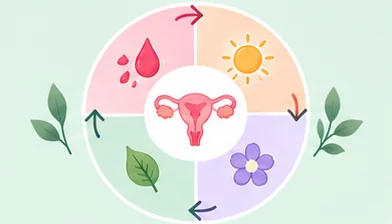
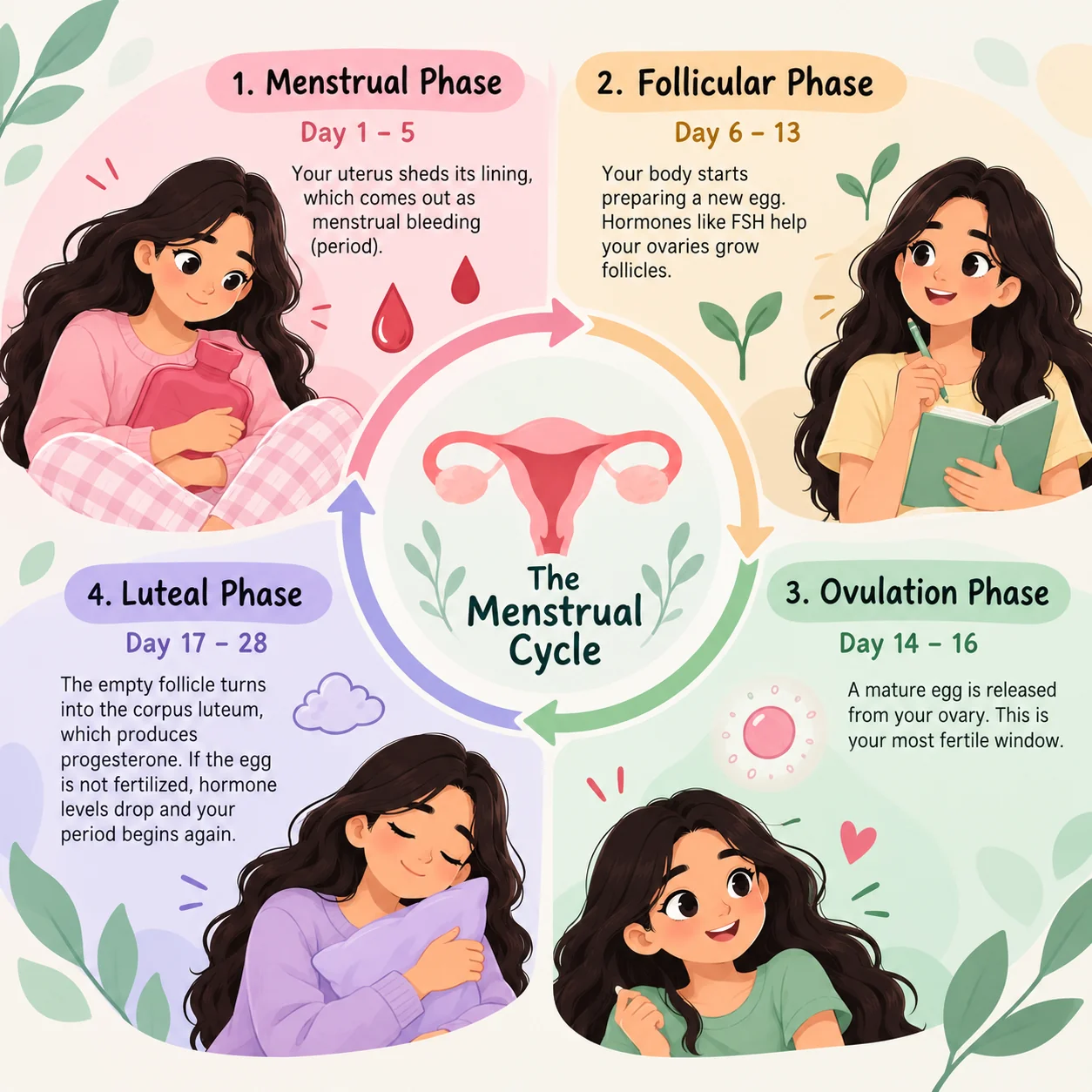
Think of your cycle as four chapters that repeat every month. Hormones rise and fall through each one, which is why your energy and mood can change too. The day numbers below are for a 28-day cycle; yours may be shorter or longer.
- Step 1Menstruation: the lining is shed (about days 1–5)
- Step 2Follicular: estrogen rises and an egg matures
- Step 3Ovulation: an egg is released (around day 14)
- Step 4Luteal: progesterone rises before the next period
2. 1. Menstruation (your period)
This phase starts on day 1 of bleeding and usually lasts 3 to 7 days. Because no pregnancy happened in the last cycle, estrogen and progesterone are at their lowest. Without them, the thick lining of the uterus breaks down and leaves the body as your period.
You may feel cramps, tiredness, low energy or lower back ache, especially in the first couple of days.
3. 2. The follicular phase
The follicular phase also starts on day 1 and runs until ovulation. A hormone called FSH (follicle-stimulating hormone) tells the ovaries to grow small sacs called follicles, each holding an immature egg. Usually one becomes the main follicle.
As the follicles grow, they make estrogen, which rebuilds and thickens the lining of the uterus. Many people notice their energy, mood and confidence lifting during this phase.
4. 3. Ovulation
A sudden surge of another hormone, LH (luteinising hormone), makes the ovary release the mature egg. This is ovulation. The egg then travels down the fallopian tube and lives for about 12 to 24 hours.
Ovulation usually happens about 14 days before your next period — not always on day 14. In a 28-day cycle that is around day 14, but in a 35-day cycle it would be around day 21.
Around ovulation you may notice clear, stretchy, slippery discharge (like raw egg white). Some people feel a slight one-sided twinge in the lower tummy.
Sperm can live inside the body for up to 5 days, so the days just before ovulation are also fertile.
5. 4. The luteal phase
After ovulation, the empty follicle turns into the corpus luteum, which makes progesterone. Progesterone keeps the uterus lining ready in case a fertilised egg arrives.
This phase is fairly steady at about 12 to 14 days. Differences in cycle length mostly happen in the follicular phase, before ovulation.
If the egg is not fertilised, the corpus luteum shrinks, estrogen and progesterone drop, and the lining is shed — your next period begins and the cycle starts again.
6. How each phase can feel
Everyone is different, but many people notice a pattern like this:
- During your period: lower energy, cramps — a good time for rest and gentle movement.
- Follicular phase: energy and mood often rise; many feel social and focused.
- Around ovulation: you may feel your most energetic, and notice slippery discharge.
- Luteal phase: later in this phase, some feel bloated, tired, emotional or have food cravings (PMS).
Tracking your mood and energy for a few months helps you learn your own pattern and plan around it.
7. FAQs
Sources & further reading
This article is general information, not medical advice. For diagnosis or treatment, please speak to a qualified healthcare professional. In an emergency, call 112.