




 Women’s Health
Technology can close the women’s prevention gap, but only if we build the rest of the system
AI, home tests and telemedicine are already reaching women that health systems missed. The evidence shows where they work, where they don’t, and what business leaders need to add to make them pay off.
Key takeaways
- 1Only about 36% of women worldwide have ever had a cervical cancer screen: 84% in high-income countries, under 20% in low- and middle-income ones.
- 2Closing the women’s health gap could add at least $1 trillion a year to global GDP by 2040, returning about $3 for every $1 invested.
- 3AI, home tests and telemedicine are already widening access, but messages, monitoring and health IDs alone have not changed outcomes.
- 4Technology pays off when it comes with access design, trust, a sustainable payer and proof of outcomes.
In this article 17 parts
- 1A gap that isn’t about missing science
- 2The prevention gap is also a $1 trillion economic gap
- 3The cost to economies and employers
- 4AI is expanding screening capacity
- 5Capacity, not reach
- 6Moving the test to the woman
- 7Telemedicine and messaging reach millions, with uneven results
- 8Monitoring alone doesn’t change outcomes
- 9The business landscape: a market defined by its definitions
- 10Venture capital is concentrating
- 11The models that scale: someone other than the woman pays
- 12The barriers that technology alone won’t fix
- 13What employers can do
- 14What investors and entrepreneurs can do
- 15What healthcare and industry leaders can do
- 16The answer
- 17Sources & further reading
A gap that isn’t about missing science
Only about 36% of women worldwide have ever had a cervical cancer screen, according to the McKinsey Health Institute and World Economic Forum. In high-income countries the figure is 84%. In low- and middle-income countries it is under 20%.
That gap is not about missing science. HPV vaccination cuts cervical cancer incidence by nearly 90%, and screening tests have existed for decades. Yet cervical cancer still kills more than 350,000 women a year, according to WHO.
So, for anyone who builds, funds or buys healthcare: can technology make preventive women’s healthcare more accessible?
The short answer is yes, but with conditions. The evidence shows technology works when it is paired with deliberate access design, trust, a sustainable payer and proof of outcomes. Without those, it stalls.
The prevention gap is also a $1 trillion economic gap
The shortfall goes well beyond cervical cancer:
- Breast cancer: for every 100 women diagnosed, 17 die in very-high-HDI countries, compared with 56 in low-HDI countries, according to IARC.
- Maternal health: about 260,000 women died from maternal causes in 2023, most of them preventably. About 92% of those deaths occurred in low- and lower-middle-income countries, according to WHO.
- PCOS: up to 70% of women with PCOS are undiagnosed, according to WHO.
- Endometriosis: diagnosis takes 4 to 12 years on average, according to WHO.
The cost to economies and employers
The cost goes beyond health systems. McKinsey Health Institute and WEF estimate that women spend about 25% more of their lives in poor health than men. Nearly half of that burden falls during working years. Closing the gap could add at least $1 trillion a year to global GDP by 2040, returning about $3 for every $1 invested.
At the employer level, the numbers are concrete:
- US: Mayo Clinic researchers put the cost of menopause symptoms at about $1.8 billion a year in lost work time.
- UK: a BSI survey published in October 2026 found that menstrual and menopausal problems cost 9.2 lost working days per affected employee per year. 49% of those women said their employer offered no support.
- Bangladesh: according to MHI, 73% of surveyed textile workers had missed work because of menstrual health issues. After workplace interventions, absenteeism fell to 3%.
AI is expanding screening capacity
The strongest evidence is in AI-supported mammography. Sweden’s MASAI randomised trial, reported in The Lancet in February 2026, involved almost 106,000 women. Compared with standard double reading, AI-supported reading:
- raised sensitivity from 73.8% to 80.5%;
- kept specificity unchanged;
- reduced radiologist reading workload by 44%, according to earlier analyses from the trial.
Capacity, not reach
Germany’s real-world PRAIM study, published in Nature Medicine, covered more than 460,000 women. It found a roughly 17.6% higher detection rate with no increase in recalls.
The gain is capacity, not reach: AI helps existing programmes do more with fewer radiologists, but does not bring unscreened women in.
Moving the test to the woman
Technologies that take the test to the woman address access more directly:
- At-home HPV self-collection: in May 2025 the US FDA approved the Teal Wand, the first at-home HPV self-collection device for cervical screening. It removes the speculum exam, although it still requires a prescription through a telehealth service.
- AI ultrasound without a sonographer: a prospective study published in JAMA Network Open, reported by Google Research in October 2026, used AI on “blind sweeps” from a low-cost handheld ultrasound probe. It estimated gestational age as accurately as expert sonographers, including at a site in Nairobi where the model had not been locally fine-tuned. It is still a research system with no stated regulatory clearance.
- Radiation-free breast screening in India: Niramai uses AI-based thermal imaging and reports community deployments, including 15,069 participants in Punjab. Most of the published evidence is company-affiliated and measures detection rates, not survival.
Telemedicine and messaging reach millions, with uneven results
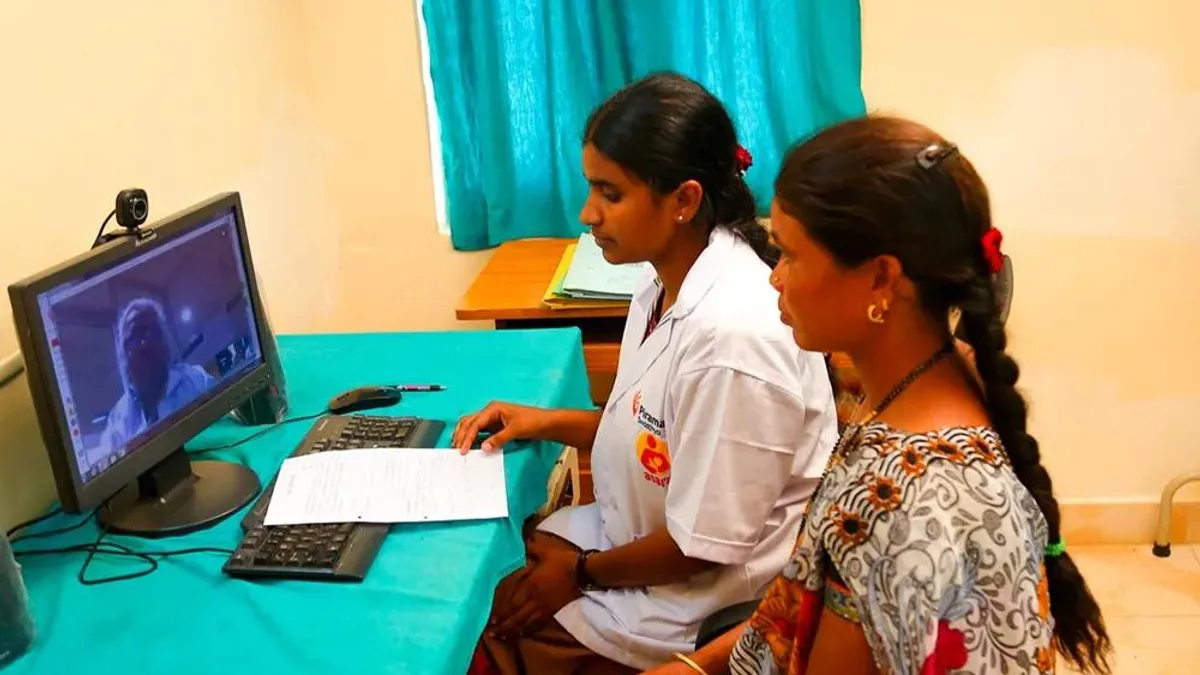
India’s public telemedicine service, eSanjeevani, passed 500 million consultations in September 2026, according to DD News. Women account for 57% of its use. It works through community “spoke” health centres, which suggests that assisted access helps women avoid travel and cost. Outcome data on screening completion has not been published.
Kilkari, a free maternal-health voice-message service, shows the limits. A randomised trial in Madhya Pradesh, published in BMJ Global Health, found it increased modern contraceptive use but did not change infant feeding practices. Women who did not own phones often never heard the messages; their husbands listened instead.
Monitoring alone doesn’t change outcomes
The UK’s BUMP trials covered more than 3,000 pregnant women and were published in JAMA. Blood-pressure self-monitoring did not detect hypertension earlier or improve its control, as reported by the University of Oxford. Data only creates value when a care pathway acts on it.
Scale is not impact, either. India’s ABHA digital health ID has more than 93 crore (930 million) accounts, according to News On AIR. Evidence that it improves women’s preventive care has not yet appeared.
The business landscape: a market defined by its definitions
Femtech market estimates vary widely depending on what is counted:
- Fortune Business Insights sizes the 2025 market at $9.1 billion.
- Global Market Insights puts it at $66.2 billion.
Venture capital is concentrating
According to Dealroom, femtech VC was $772 million in 2025 and is projected at about $500 million for 2026. Femtech’s share of all health VC has fallen from 2.2% in 2016 to 0.6%.
Capital is flowing to a few later-stage clinical players. Examples include Midi Health’s $100 million Series D in menopause care and Pomelo Care’s $92 million Series C in maternity care. Philanthropy is filling part of the gap: the Gates Foundation has committed $2.5 billion to women’s health R&D through 2030.
India is small but accelerating. Tracxn data reported by YourStory shows Indian women’s healthtech startups raised $40.5 million in 2025, up 334% from 2024.
The models that scale: someone other than the woman pays
The models that scale have one thing in common: someone other than the woman pays.
- US employers: fertility benefits went mainstream once employers paid for them. 42% of US employers now offer fertility benefits, up from 30% in 2020, according to Healthcare Dive. Menopause is where fertility was a decade ago: only about 5% of US employers offer menopause-specific benefits, according to an NFP survey reported by SHRM.
- Emerging markets: the working route is institutional, pay-per-use pricing. Niramai sells per scan or in prepaid packs to hospitals, insurers, NGOs and government programmes, which, as the company puts it, “can make screening free for women”.
The barriers that technology alone won’t fix
- The digital gender divide: according to GSMA, 885 million women in low- and middle-income countries don’t use mobile internet. South Asia has the widest gender gap, at 32%. An entry-level handset costs a woman 24% of her monthly income, compared with 12% for a man. An app-first model in India misses a large share of the women it is meant to serve.
- Privacy and trust: in August 2025, a California jury found Meta violated state privacy law by collecting menstrual-health data from Flo app users, as TechCrunch reported. India’s DPDP Rules, notified in November 2025, allow penalties of up to ₹250 crore for security failures. In a category this sensitive, trust is part of the product.
- Reimbursement: employer fertility carve-outs exist because standard health plans often exclude fertility care. Most preventive femtech still lacks a routine payer.
- Bias in the evidence base: according to MHI and WEF, 64% of 183 interventions studied put women at a disadvantage, and only half reported sex-disaggregated data. Women are also diagnosed later than men for more than 700 diseases. AI trained on that history can inherit its blind spots.
- Weak evidence: outside mammography, most low-resource tools have accuracy data but no outcome trials. Buyers should know the difference.
What employers can do
- Treat women’s preventive health as a productivity line item. The BSI and Mayo figures make the case.
- Fund screening, menopause and menstrual-health support as covered benefits, not optional apps.
- In India and other emerging markets, bring screening on site, for example through workplace camps. Don’t rely on downloads.
- Ask vendors for outcome data, not engagement metrics.
What investors and entrepreneurs can do
- Back models with an institutional payer: employers, insurers, state programmes or CSR budgets.
- Price for low-capital buyers, for example pay-per-screen.
- Design for assisted delivery through health workers, so the product works for women without smartphones.
- Build privacy in from the start: no ad-tech data flows, and DPDP-ready consent.
- Budget for independent validation early. Evidence becomes a competitive advantage.
What healthcare and industry leaders can do
- Deploy AI where workforce shortages are the bottleneck.
- Pair self-sampling and point-of-care tools with clear follow-up and treatment pathways. BUMP shows that data without action changes nothing.
- Report results by sex, and push to restore the indicators missing from national surveys such as NFHS-6. Without measurement, there is no accountability.
The answer
Yes, technology can make preventive women’s healthcare more accessible, and in places it already does. Examples include AI expanding mammography capacity, home HPV tests and women making up the majority of users on India’s public telemedicine service.
But the failures follow a pattern. Messages don’t reach women without phones. Monitoring doesn’t help without a clinical response. Health IDs register people without changing care. Technology lowers the cost of reaching a woman, but it does not pay for her care, earn her trust or prove that it worked.
The winners will treat those as design requirements, not afterthoughts.
At PIAX, we believe this is where business leadership matters most.
PIAX on YouTube
Watch and learn 1 video
Sources & further reading
- World marks Cervical Cancer Elimination Day (17 Nov 2025)World Health Organization
- Closing the women’s health gap: a $1 trillion opportunity to improve lives and economiesMcKinsey Health Institute
- MASAI randomised trial results (Feb 2026)The ASCO Post
- eSanjeevani crosses 50 crore milestone (Oct 2026)DD News
- BUMP trials: self-monitoring of blood pressure in pregnancy (May 2022)University of Oxford
- Femtech guide (updated Oct 2026)Dealroom
- Mobile Gender Gap Report 2025GSMA
- Jury rules Meta violated California privacy laws by collecting menstrual health data from Flo (Aug 2025)TechCrunch
This article is general information, not medical advice. For diagnosis or treatment, please speak to a qualified healthcare professional. In an emergency, call 112.